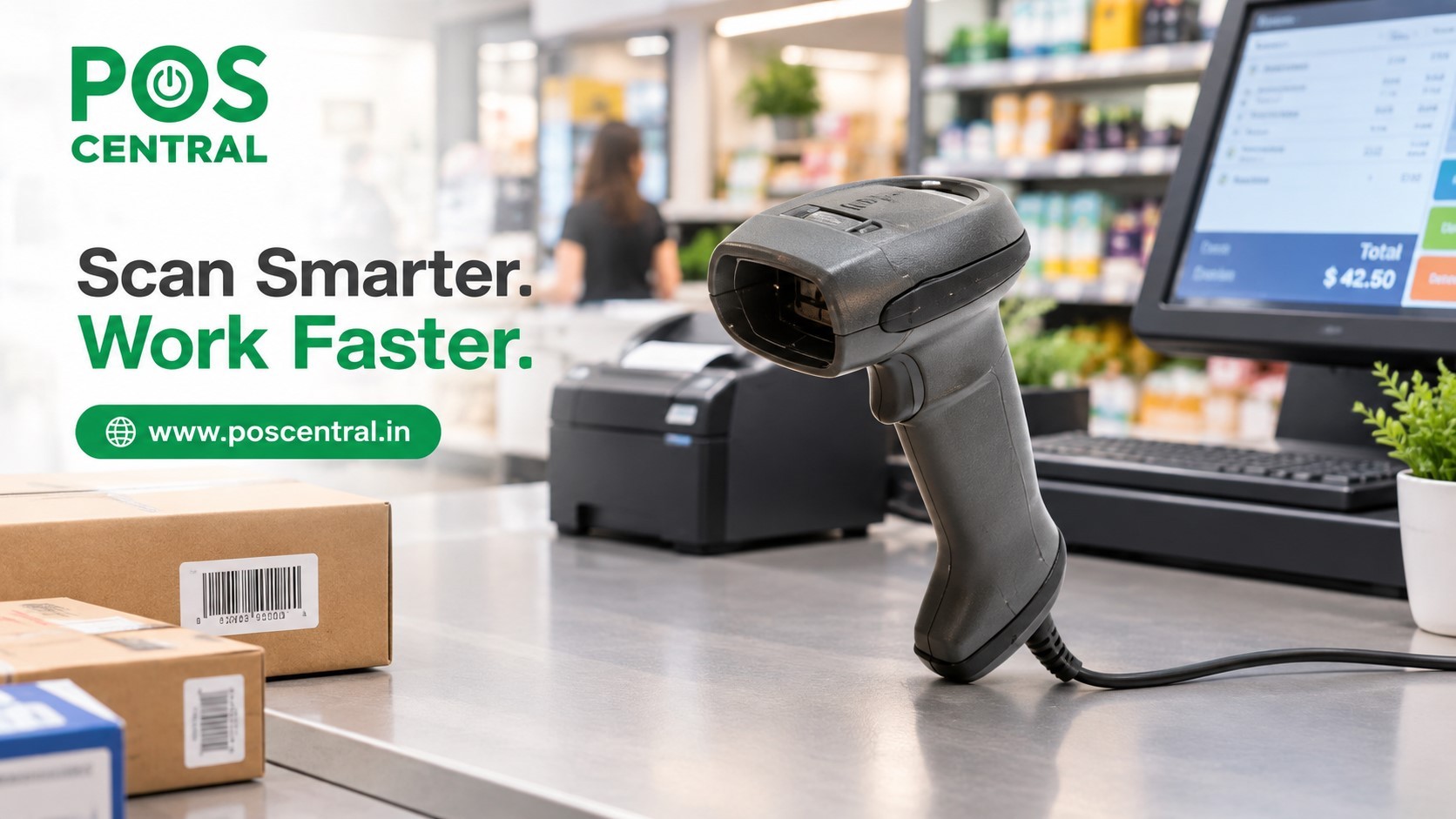
Walk into a retail store, warehouse, pharmacy, or busy checkout counter, and you will often see products moving from shelves to the billing desk with just a quick scan. That small action can save time, reduce manual entry, and make everyday work easier. As businesses handle more products and transactions, barcode scanning has become a practical part of many daily operations.
Modern barcode scanners are used across retail, inventory, logistics, warehouses, pharmacies, and POS counters. Different businesses may need different types, depending on the products they handle, the volume of scanning, and how their work area is arranged.
Why Do Businesses Use Barcode Scanners?
A barcode scanner reads the information stored in a product barcode and sends it to a connected computer or billing system. Instead of typing product details manually, staff can scan the code and continue with the next task.
This can be useful when a store handles a large number of products every day. It can also make repeated tasks more convenient for employees who regularly check stock, process orders, or identify products.
The right barcode scanner can support a smoother workflow without changing the basic way employees work.
How Do Barcode Scanners Help With Billing?
At a busy checkout counter, every second matters. Searching for product codes or entering numbers manually can take extra time. A scanner allows staff to identify products quickly and pass the information to the POS system.
This is particularly useful for supermarkets, retail stores, pharmacies, and other businesses where many items are processed during the day.
A wired scanner may work well when the device stays beside the billing counter. A wireless model can be more useful when employees need to move around the store or stock area.
How Are Barcode Scanners Used for Inventory?
Inventory work often involves checking, receiving, moving, and identifying products. Doing these tasks manually can become difficult when there are hundreds or thousands of items.
A barcode scanner can help employees identify products during stock checks and receiving activities. In a warehouse, for example, staff may scan items while preparing orders or moving products between locations.
The benefit is not simply speed. Scanning can also reduce the need to repeatedly type product numbers, making routine stock work easier to manage.
1D or 2D Barcode Scanner: Which One Do You Need?
The choice between 1D and 2D scanning depends on the type of codes a business needs to read.
A 1D barcode scanner is designed mainly for traditional barcodes made of lines. These are commonly seen on many retail products.
A 2D barcode scanner can read two-dimensional codes and is also suitable for many traditional barcode formats. This makes it useful for businesses that work with different types of codes, including QR-style codes.
Before choosing a model, check the types of barcodes used in your business rather than selecting a device simply because it has more features.
Wired vs Wireless Barcode Scanners
Both wired and wireless barcode scanners have useful applications.
A wired scanner is a straightforward option for a fixed checkout desk. USB models can be convenient where the scanner remains connected to the same computer or POS setup.
A wireless barcode scanner offers more freedom of movement. It can be useful in warehouses, larger retail spaces, stock rooms, and situations where employees need to scan products away from the counter.
If you are looking for a wireless barcode scanner online, consider the working distance, connection method, charging needs, and expected daily use before making a choice.
What Should You Check Before Choosing a Barcode Scanner?
There is no single best barcode scanner for every business. The right option depends on the work being done.
Consider these points before choosing:
Barcode type: Check whether you need 1D, 2D, or both.
Connection: Choose between USB, serial, Bluetooth, or another suitable option.
Scanning style: Handheld models suit mobile tasks, while hands-free options can work well at fixed counters.
Work environment: A warehouse may need a more durable scanner than a small office.
Scanning volume: High-volume checkout work may require a scanner designed for frequent use.
Compatibility: Make sure the scanner works with the computer or POS setup being used.
Movement: Consider whether staff will scan products only at a counter or throughout a work area.
These factors are more useful than simply searching for the best barcode scanner in India without considering the actual workflow.
Where Do Modern Barcode Scanners Fit Into Business Operations?
Barcode scanners are no longer limited to traditional checkout counters. They can support different stages of everyday work.
Retailers may use them for billing and product identification. Warehouses can use them for stock movement and order handling. Pharmacies may use scanning during product checks, while logistics operations can use scanners when processing goods.
The range of available scanners also reflects these different needs. Current options include handheld, wireless, hands-free, 1D, and 2D models for different environments.
What Does the Future of Barcode Scanning Look Like?
Barcode scanning is becoming part of more connected business workflows. The wider use of 2D codes, wireless devices, flexible checkout areas, and digital inventory systems is creating more ways for businesses to use scanning.
The important point is that newer technology does not automatically mean every business needs the most advanced device. A small retail counter may need a simple wired scanner, while a warehouse may benefit from a mobile option.
The best approach is to match the scanner with the actual work.
A barcode scanner is a small part of a larger business workflow, but the right device can make repeated tasks easier and more organised. Instead of choosing based only on price or features, consider the type of barcode, daily workload, connection, workspace, and POS requirements. For businesses exploring practical scanning options, POS Central India provides a range of barcode scanners for different business needs.
Frequently Asked Questions
What is a barcode scanner used for?
A barcode scanner is used to read product or item codes and transfer the information to a connected system. It can support billing, inventory checks, product identification, order processing, and other routine business tasks.
Are barcode scanners useful for small businesses?
Yes. Small stores can use scanners for checkout, stock checking, and product identification. The important factor is choosing a model that matches the store's product range, scanning volume, and existing POS setup.
Is a 2D scanner better than a 1D scanner?
Not in every situation. A 2D scanner may be suitable when a business needs to read different types of codes, while a 1D scanner may be sufficient for businesses using traditional linear barcodes.
Can barcode scanners work with POS systems?
Many barcode scanners are designed for use with POS environments, but compatibility depends on the scanner, connection type, and software setup. Checking these requirements before purchase can help avoid connection problems.
Are wireless scanners useful for warehouses?
They can be useful when employees need to move between shelves, storage areas, or workstations. The suitable model depends on factors such as working distance, connectivity, battery needs, and the warehouse environment.